Letter Boxed Unlimited: Play Free Puzzles With No Daily Limit
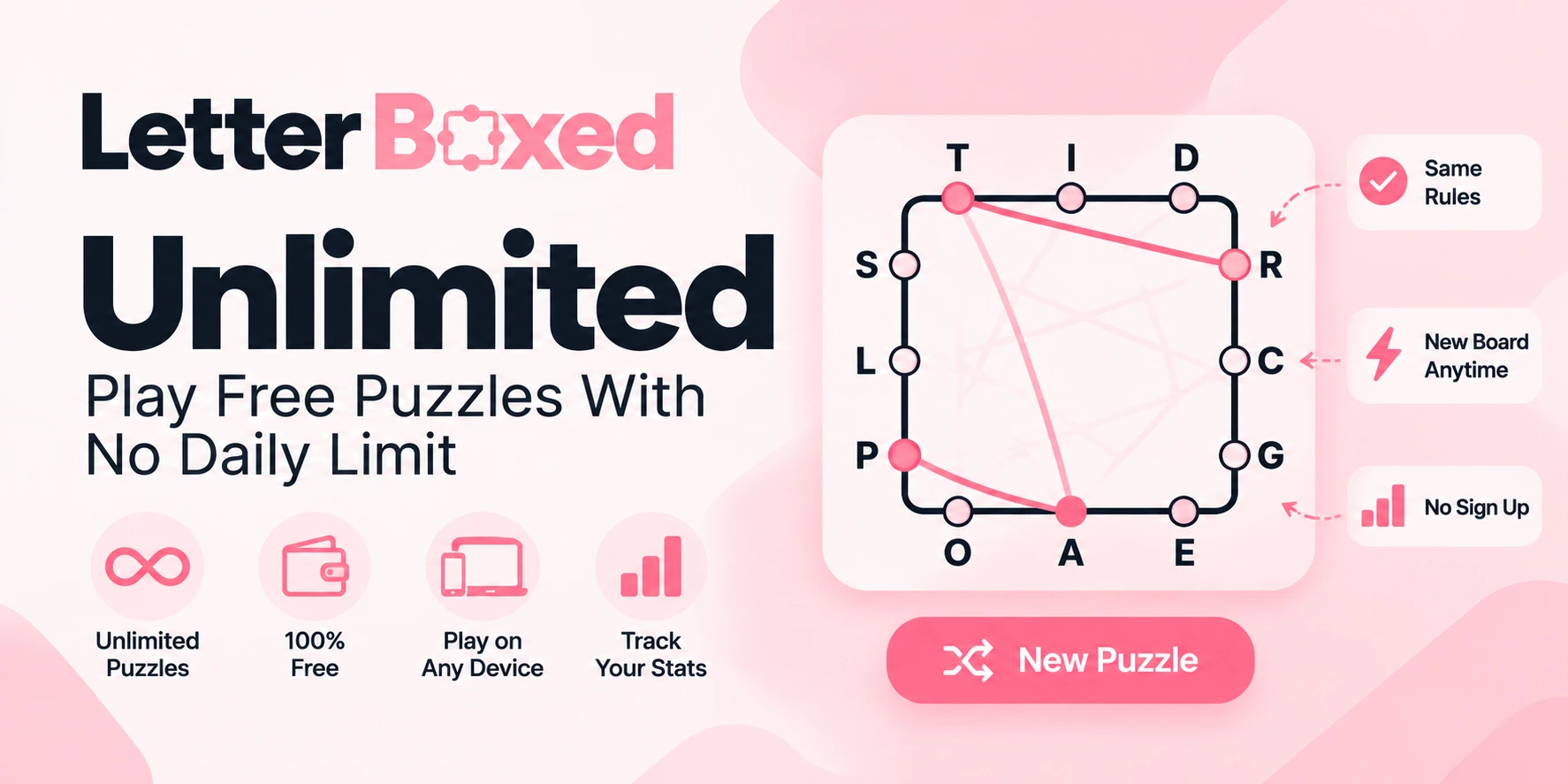
Letter Boxed Unlimited lets you play the Letter Boxed word puzzle as many times as you want. Finish a board and a fresh set of 12 letters is ready. There is no daily cap, no sign up and no subscription. Pick the Unlimited tab above the board and start your first chain.
At a glance
- Price: free
- Boards: a new one every time you press New Puzzle
- Rules: the same rules as the New York Times game
- Devices: any phone, tablet or computer browser, with nothing to download
- Stats: games played, win rate, streak and best word count on this device
What Is Letter Boxed Unlimited?
Letter Boxed is a daily word puzzle from The New York Times. Puzzle editor Sam Ezersky created it. The Times launched it in February 2019 as its third digital game, after the Crossword and Spelling Bee. The official game gives you one board per day, and a new one appears at 3 a.m. Eastern Time.
Unlimited mode removes that wait. You solve a board, then load the next one. Our boards follow the same rules, but they are our own puzzles. They are not copies of the NYT daily board. This site is independent and has no link to The New York Times.
Why players want an unlimited version
Two reasons come up again and again. The first is simple. One puzzle a day goes fast, and many players want a second or third board.
The second reason is access. In late August 2025, the Times moved Letter Boxed, Tiles and the Mini Crossword behind its Games subscription. Kotaku reported that free players lost access with no warning. A free unlimited board fills both gaps, so you can keep your daily habit without paying.
How to Play Letter Boxed Unlimited
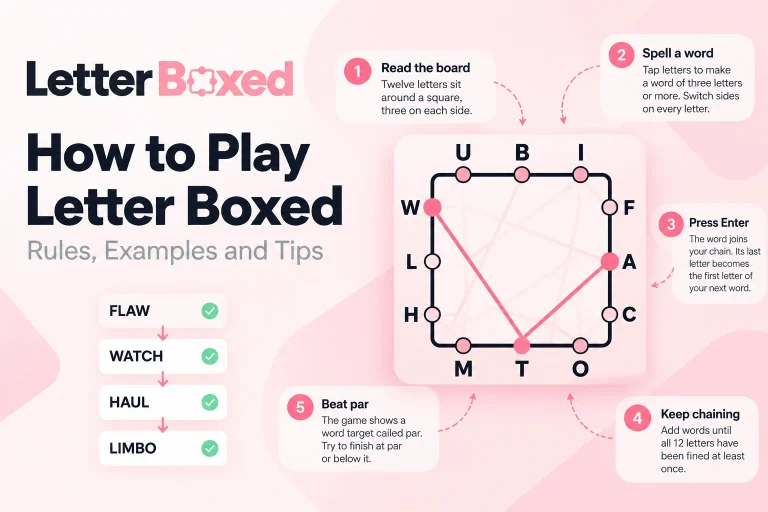
The board is a square with three letters on each side. Your job is to use all 12 letters by linking words into one chain. Five rules decide every move.
- Words need at least three letters. Two letter words like AT or IN do not count.
- Switch sides on every letter. Two letters in a row cannot come from the same side.
- Chain your words. Each new word starts with the last letter of the word before it.
- Use every letter at least once. You can reuse letters as often as you like.
- Stick to real words. Proper nouns and profanity are not accepted.
The side rule trips up most new players. You can return to a side later in the same word. You just cannot stay on it for two letters in a row.
Using the controls
- Tap or click letters to spell a word.
- Press Enter to lock the word into your chain.
- Press Delete to remove the last letter.
- Press Restart to clear the board and try a new path.
- Watch the counter. It shows how many of the 12 letters you have used.
When the counter reaches 12, the board is solved. Press New Puzzle for the next board, or Share Result to send your score to a friend.
A worked example
Here is a real board and a two word solve.
| Side | Letters |
| Top | T, I, D |
| Right | R, C, G |
| Bottom | O, A, E |
| Left | P, L, S |
Word 1: TROPICAL. Trace it: T (top), R (right), O (bottom), P (left), I (top), C (right), A (bottom), L (left). Every step moves to a new side, so the word is legal.
Word 2: LODGES. It starts with L, the last letter of TROPICAL. Trace it: L (left), O (bottom), D (top), G (right), E (bottom), S (left).
Those two words cover all 12 letters. Now look at a word that fails. TIDE starts with T and I, which both sit on the top side. The game rejects it before you reach the third letter.
Letter Boxed Unlimited vs the NYT Daily Puzzle
Both games use the same square, the same 12 letters and the same chain rule. The real differences are access and pace.
| Feature | Unlimited on this site | NYT Letter Boxed |
| Price | Free | Needs an NYT Games subscription |
| Boards per day | As many as you want | One |
| New board | Any time you press New Puzzle | Daily at 3 a.m. Eastern Time |
| Account | None | NYT account |
| Rules | Same five rules | Same five rules |
| Word target | Par shown on each board | Par set by NYT editors, usually 4 to 6 words |
| Past answers | Check boards with our solver | A Yesterday button shows a two word answer to the previous puzzle |
| Who makes the boards | Our own puzzle set | NYT puzzle editors |
Which one should you play?
Play the NYT daily if you have a subscription and enjoy solving the same board as everyone else. The shared puzzle is great for comparing scores with friends.
Play unlimited when you want more boards, have no subscription, or want to practice. Many players use both. They warm up on a few free boards, then tackle the daily puzzle with a sharper eye.
How to Solve in Fewer Words
Letter Boxed Unlimited is the fastest way to get better, because you can test one idea many times in a row. These six habits cut word counts the most.
1. Scan for hard letters first
Look for J, Q, X, Z, V and K before you type anything. Few words use them, so place them early while the whole board is still open. Tuck them inside a word, as in BLAZING or EXPLORE, rather than at the end.
2. Choose your last letter before your first
Your last letter becomes the first letter of the next word. S, T, D, R and E start a huge number of English words. Ending on Q, X or J usually leaves you stuck.
3. Find one long word
A word of seven or eight letters clears most of the board in one move. Look for words that zigzag across all four sides. Common endings like ING, ED, ER and TION help you stretch a short word into a long one.
4. Plan the bridge letter
The bridge letter ends word one and starts word two. Before you press Enter, ask a simple question. Can I name a word that starts with this letter and covers what is left? If not, change the ending.
5. Use vowels with care
Vowels hold most words together. When two vowels sit on the same side, you can never place them back to back. Spread your vowel use across both words so the second word is not left with only consonants.
6. Restart instead of patching
Adding short words to rescue a weak chain raises your count fast. On an unlimited board there is no cost to starting over. Press Restart and try a new opening word.
Practice drills for unlimited mode
- Hard letter drill. Skip any board without J, Q, X or Z. Solve only the tough ones for a week.
- Five letter floor. Ban words shorter than five letters for ten boards in a row.
- Two word hunt. Keep loading boards until you land a two word solve. Note which bridge letter made it work.
- Speed round. Set a phone timer for three minutes and see how many boards you can clear.
After each board, compare your chain with the shortest one. Enter the same letters in our Letter Boxed solver to see every path you missed. Reviewing a solved board teaches more than rushing into the next one.
What Counts as a Good Score?
Letter Boxed has no points. Your score is the number of words in your chain, and fewer is better. Each board shows a par, which is the target to beat.
| Words used | What it means |
| 2 | The best result most boards allow |
| 3 | A strong, well planned solve |
| At par | A solid result |
| Above par | Normal while you learn the side rule |
On the NYT board, the Yesterday button reveals a two word answer for the previous puzzle. Some unlimited boards are tougher, so beat par first and treat two words as a bonus.
Why a Daily Word Puzzle Is Worth Your Time
Word games do more than pass time. A 2019 study led by Dr Anne Corbett at the University of Exeter tracked more than 19,000 adults aged 50 and over. People who did word puzzles more often scored better on tests of attention, reasoning and memory. On grammar reasoning, regular players scored like people about ten years younger.
The researchers were careful to say this shows a link, not proof of cause. Still, Letter Boxed asks for exactly those skills. You hold a word chain in memory while you plan the next move.
Can You Play at School or Work?
Yes, in most cases. Letter Boxed Unlimited runs in your web browser. There is nothing to install, no plugin and no login. That is why it usually works on school Chromebooks and work laptops.
If a page will not load, the network has blocked it. That is a filter set by your school or company, so check their rules before you play.