Letter Boxed vs Spelling Bee
Letter Boxed and Spelling Bee are both daily NYT word games, but they test different skills. Letter Boxed asks you to chain words and use all 12 letters in as few words as possible. Spelling Bee asks you to find as many words as you can from seven letters.
Pick Letter Boxed if you like planning a path. Pick Spelling Bee if you like hunting for words and chasing ranks. Both refresh at 3 a.m. Eastern.
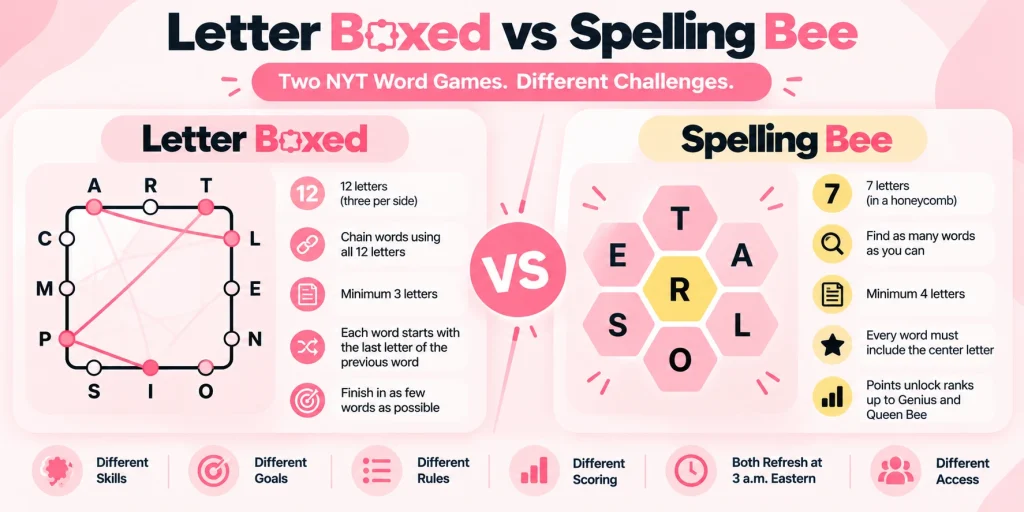
| Feature | Letter Boxed | Spelling Bee |
| Letters | 12, three on each side of a square | 7, in a honeycomb |
| Goal | Use every letter in as few words as possible | Find as many words as you can |
| Minimum word length | 3 letters | 4 letters |
| Key rule | Each word starts with the last letter of the one before. No two letters in a row from the same side. | Every word includes the center letter |
| Reusing letters | Yes | Yes |
| Scoring | Par score, with a target set by the game | Points that unlock ranks, up to Genius and Queen Bee |
| New puzzle | 3 a.m. Eastern | 3 a.m. Eastern |
| Free access | No, subscription required | Limited |
| Creator | Sam Ezersky, released 2019 | Frank Longo, print 2015, daily online 2018 |
How Letter Boxed Works
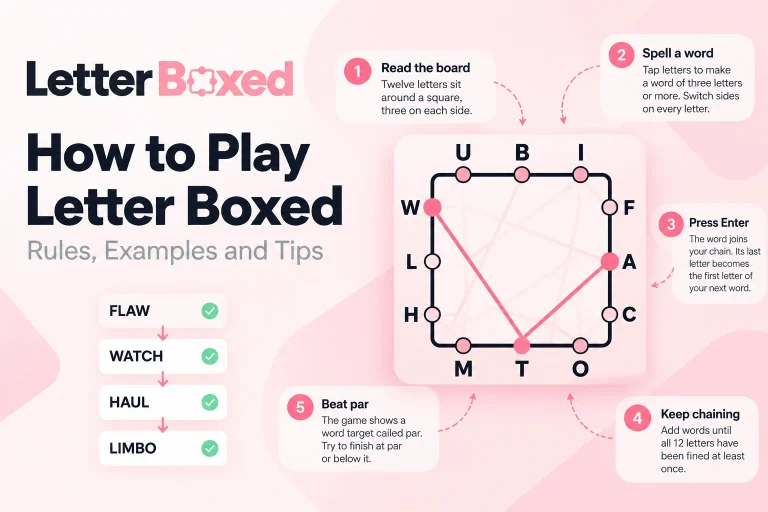
Letter Boxed puts 12 letters on a square, three per side. You spell words of at least three letters. Each word must start with the last letter of the word before it. No two letters in a row can come from the same side.
You can reuse letters. The goal is to touch every letter in as few words as possible. The game sets a target, which usually falls between four and six words, according to Wikipedia. The NYT calls your final total a par score.
NYT editors curate the word list, so some dictionary words fail. Proper nouns and hyphenated words are out. Adjectives are accepted, per the NYT Help Center.
New to the game? Our how to play guide walks through a full board.
How Spelling Bee Works
Spelling Bee gives you seven letters in a honeycomb. One sits in the center, and every word must include it. Words need at least four letters. You can reuse letters as often as you like.
Four letter words score one point. Longer words score one point per letter. Each puzzle holds at least one pangram, a word that uses all seven letters. A pangram earns seven bonus points, so a seven letter pangram is worth 14, per Wikipedia.
Points unlock ranks such as Solid, Amazing and Genius. Find every possible word and you reach Queen Bee. Genius sits near 70 percent of the day’s total. On October 15, 2026, it took 244 of 348 points, based on Nerdschalk’s daily breakdown.
Letter Boxed vs Spelling Bee: The Key Differences
The goal
Letter Boxed is a cover puzzle. You finish when every letter has been used, and fewer words is better. Spelling Bee is a collection puzzle. You stop whenever you want and keep climbing the ranks as long as you keep finding words.
The constraint
In Letter Boxed, the sides decide which letter can follow which. Your last letter also decides how the next word starts. One choice shapes the next.
Spelling Bee has one hard filter: the center letter. Words never connect to each other, so a miss costs you only that word.
The scoring
Letter Boxed counts words against a par score. Spelling Bee counts points toward a rank. That is why a Letter Boxed solve feels like finishing a task, and a Spelling Bee session feels like a running tally.
Which Is Harder?
The NYT does not publish a difficulty rating, so the answer depends on you.
The Harvard Crimson wrote that Letter Boxed looks simple but gets hard fast, as Wikipedia notes. A Miami Student writer found the word list frustrating, citing words like azurite and erythrocyte. In Spelling Bee, the pressure comes from breadth. Genius needs about 70 percent of the points, and Queen Bee needs every word.
Here is a fair rule of thumb. Letter Boxed punishes a weak plan. Spelling Bee punishes a thin vocabulary.
What Each Game Trains
- Letter Boxed: planning ahead. You judge a word by its last letter before you submit it.
- Spelling Bee: vocabulary range and pattern spotting. Finding the pangram often decides your rank.
Who Made Each Game
Frank Longo created Spelling Bee after Will Shortz proposed the idea. Shortz drew on a British puzzle in The Times, according to Wikipedia. The game debuted in print in The New York Times Magazine on February 22, 2015. The daily online version launched on May 9, 2018, with Sam Ezersky as its editor.
Ezersky created Letter Boxed. It launched in 2019 after a 2018 soft launch. It was the third game on the NYT puzzles site, after the Crossword and Spelling Bee.
Cost and Access
The NYT lists Spelling Bee as free with limited access. It lists Letter Boxed as subscription only. A Games, All Access or Home Delivery plan includes both, per the NYT Help Center.
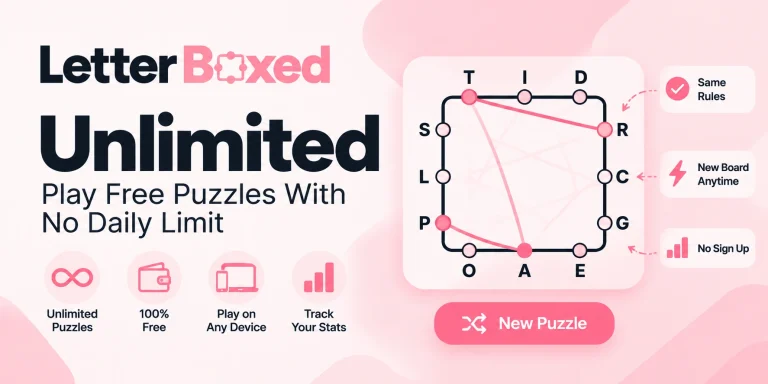
For the full breakdown, read our guide on whether Letter Boxed is free. If you want extra practice boards, our Letter Boxed Unlimited page is free. It is independent and uses its own boards, not the NYT’s.
Which Should You Play?
- Pick Letter Boxed if you like a clear target and a planning challenge.
- Pick Spelling Bee if you like hunting for words at your own pace.
- Stuck on a Letter Boxed board? Try our solver after a real attempt.
- Want both? Play them back to back. Each resets at 3 a.m. Eastern.
Frequently Asked Questions
What is the main difference between Letter Boxed and Spelling Bee?
Letter Boxed asks you to chain words and cover all 12 letters in as few words as possible. Spelling Bee asks you to find as many words as you can from seven letters. One rewards planning. The other rewards vocabulary.
Is Spelling Bee harder than Letter Boxed?
Neither is harder across the board. Letter Boxed punishes weak planning, because a bad ending letter can stall your chain. Spelling Bee punishes a small vocabulary, because the Genius rank needs about 70 percent of the day’s points.
Are both games free?
Not fully. The NYT lists Letter Boxed as subscription only. Spelling Bee gives free players limited access, which means a few words before the paywall. A Games, All Access or Home Delivery plan unlocks both.
Can you reuse letters in both games?
Yes, in both. Letter Boxed lets you reuse letters, but never two in a row from the same side. Spelling Bee lets you repeat letters as often as you like, as long as every word includes the center letter.
When does a new puzzle come out?
Both reset at 3 a.m. Eastern, which is midnight Pacific. Each day brings a new square in Letter Boxed and a new honeycomb in Spelling Bee, so you can play both back to back.
Who created Letter Boxed and Spelling Bee?
Frank Longo created Spelling Bee, which debuted in print in 2015. Sam Ezersky created Letter Boxed, released in 2019, and has edited Spelling Bee online since its 2018 debut. Both now live in NYT Games.
Which game should a beginner play first?
Pick Spelling Bee if you like hunting for words at your own pace. Pick Letter Boxed if you like a clear target and planning. Both have short rules, so try each for a day.
How We Checked This Page
We compared the NYT Help Center pages, Wikipedia’s entries for both games and their cited sources, and daily puzzle data from October 2026. The NYT can change access or scoring without notice. Confirm on its pages before you subscribe.